
From URL to IRL: The rise of phone-free events
Event ROI: How to measure what matters

The long-term impact of meaningful engagement at events is undeniable, with over half of marketers saying that event marketing drives more business value than other channels.
Yet,70% of organisers struggle to measure and demonstrate return on investment (ROI)effectively. The challenge isn’t whether or not events deliver meaningful business outcomes, it’s in how we measure and position their impact to justify spending and secure budgets.
The challenge of measuring event ROI
Unlike digital marketing campaigns, where every click can be tracked in real-time, the impact that events have on their audience unfolds over time and attribution can be hard to trace back to a specific touchpoint.
Part of an event organiser’s role, however, is to put that impact into numbers and create a commercial story that feeds back to the business and educates stakeholders on the value that’s offered from an event. That way, when it comes to budget allocation there is a credible, justified, and demonstrable reason to invest into the event and the marketing. Event planners can showcase amazing engagement, videography and qualitative feedback but often what’s missing is a financial story and how connections made at events can feed the pipeline.
This is a complex challenge that requires a custom approach and something that traditionally events’ organisers have typically struggled to report. Marketing over the last few years has been dominated by a revenue driven model that measures how many MQLs (marketing qualified leads) an activity or campaign generates, and how much revenue this generates in turn. In the case of an events based campaign however, it can take longer to see that return on investment.
Event planners are proving the buyer journey involves something more than just short term MQL approaches and there’s a long-term story. In particular the 95-5 rule is a great way to rethink the pipeline approach. So how can planners translate that into a clear picture for budget owners?
The financial story of events: events are not lead generation channels
The bottom line is that people don’t attend events to be sold to.
Event planners have to balance return on investment with return on experience, which means going beyond just fulfilling company objectives but providing the best possible experience for your attendees that makes them want to register year on year.
Live interactions offer the opportunity for brands to differentiate themselves as a partner over a vendor. Someone who understands their audience and cares about their values. By facilitating conversations, events can provide a front row seat to your audiences’ challenges where your sales team are learning alongside them, rather than selling to them. Shift your goals away from having a team member on every panel, to providing your audience the chance to hear from top voices and take part in meaningful interactions that meet your audience’s needs and provide real value they can’t get elsewhere.
Taking this approach to building brand and relationships overtime may be harder to argue to budget holders, yet it has proven to have a greater effect on sales uplift than sales activations. Therefore, to balance these two principles, you need to think about long term measurement. It’s important to track engagement over the full customer journey, looking at how audiences interact both online and offline throughout the year with live interaction dots across customer journey profiles and key accounts. This enables you to take ownership of leads and better measure account penetration and cost per opportunity.

Beyond Vanity Metrics: Net Promoter Score
Net promoter score (NPS) asks would you recommend the brand to someone else on a scale of one to ten. It segments audiences into promoters (those that score a nine or ten), passives (those that score seven or eight), and detractors (those that score a zero to six), with the final score calculated as the percentage of promoters minus the percentage of detractors.
NPS is a core metric used by event teams to create a bigger picture across multiple events and global audiences. It reframes measurement from one event and short-term metrics to focus on long-term indicators of engagement and how relationships are being moved forward – serving as a benchmark to see improvement overtime. It also enables you to see if there was something at a particular event that brought the score down.
Adjusted NPS enables contextual understanding for example you can analyse NPS by event type and region. This allows you to overcome the challenge that different cultures will score differently, so adjusting the score to the context that an audience in Japan for example will likely score low and an audience in Mexico will likely score high allows us to compare those relationships around the world.
Contextual driven, consistent metrics like this over vanity metrics demonstrate real business impact that engages stakeholders in a story. While planners must report revenue metrics to leadership, sentiment shows data doesn’t have to be numbers. It shows how an audience feels about a brand, what they’ve learned from an event, and what the planners learned from the audience.
Maximising event ROI isn’t just about post-event reporting
It starts in the planning phase and continues through execution and follow-up. Some key strategies including defining clear goals and the target audience pre-event, using technology like smart badges on site to track engagement, and nurturing leads post event.
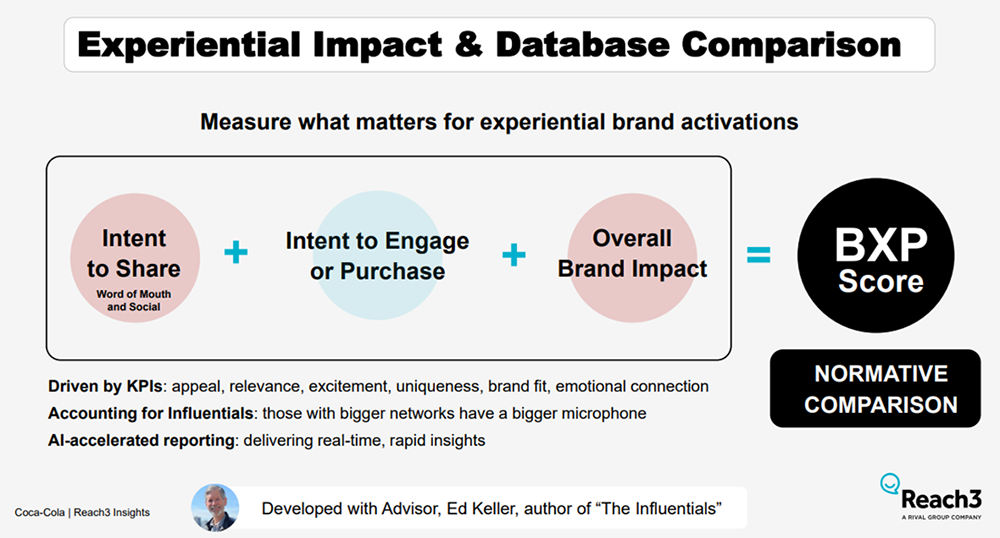
Coca-Cola, is leading the way in advancing beyond traditional surveys as it seeks to measure the impact of in-person brand experiences with a comprehensive measurement strategy for experiential marketing that seeks to predict the impact of a brand experience to tackle the challenge of isolating the impact of their events within larger campaigns. The Brand Experience Predictor (BXP) uses phases of feedback across the event: pre-testing which seeks to predict the performance of the event through customer expectations, in-moment feedback provided by customers during the event, and a post-experience reflection from participants who attended. The model means all the information across different events that goes into a database is in a common language that makes comparison over time simpler.
How event planners can use technology to make ROI reporting simpler
Technology is shaping a future which provides intelligent analysis of event engagement and a way of measuring granular engagement on-site. The level of analysis in football analytics, that track every element of the game including the movement of the ball and the players, can be applied in this context to analyse live interactions see where event participants dwell. RIFD-based badges, for example, can track movement throughout an event.
Artificial Intelligence should also be used as a tool to generate rapid insights into the performance of an event, simplifying complex, fragmented data such as attendance, engagement and revenue impact into clear themes. This rapid analysis can be applied to make a multi-day event smoother after just one day, improving the experience immediately and generating better outcomes. Alternately, AI can be deployed to analyse themes emerging in media and customer forums to evidence buzz in your market. AI can be used to dig out these insights the human eye can’t see.